Bursting Balloons !

Bursting Balloons !
click on image for more

Tuesday, July 6, 2010

Canon vs Nikon flash studies .

As of  7 July 2010 I am inviting test shots from Canon users to try to 'reverse engineer ' Canon's flash system in a similar way to what I did with Nikon TTL-BL mode .
So far Stefan on photocamel has provided me with these images from the 7D and a 430 EX flash and the results are interesting .
Test 1.) 


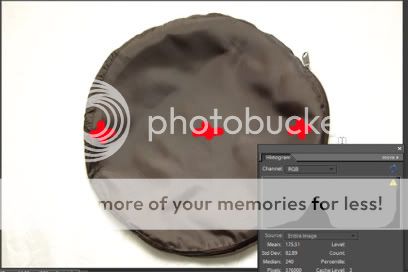
The histograms of both the 'near' focus and 'far' focus both went down instead of the 'far' focus increasing exposure as with TTL-BL mode . I was expecting the distance info from the lens to tell the flash system to increase output when the focus was changed to infinity but the opposite happened ?
Perhaps when the camera doesn't detect anything in focus it reverts to plain "average gray" metering for the flash ? 
Now we are in the really early stages of doing these tests and nothing has been double checked by others yet so I still welcome input . I would like to go through all the tests as shown in my TTL-BL blog to see what we can work out and compare Canon and Nikon flash systems just for interest and for those who would like to learn the 'nuts and bolts' of the systems .

This is how Nikon's TTL-BL handled the situation .


When the flash system detected that focus distance was at its maximum it increased exposure without showing too much regard for the out of focus white in the foreground .
Compared to what Canon ETTLii does for the moment I see this as an advantage .
There are probably very few people who use manual focus indoors but for anyone who does manually select a focus distance the Canon flash system will instantly lose any advantage distance information from the lens would have given it if the camera doesn't agree that anything is in focus .
However with the run of problems with canon auto-focus who know what the camera may deem to be 'in-focus' ;) .


So the question now is " Does Canon ETTLii totally drop the distance information when it doesn't detect 'focus confirmation ?"
Anyone interested in doing the tests , this is the scenario we need :
Test 2.) 


Please excuse the creepy looking baby but "Stinky" was my model back then .
Have a white object close to the camera and covering half the frame . Place the subject next to the reflector , take a picture , and then quite a distance behind it and take some pictures .
 Nikon's TTL-BL ignored the white object and concentrated on what was in focus at the right distance .
Then set focus on infinity and take another picture .
This will tell us if ETTLii  uses the lens distance info when the subject is in focus and whether it totally drops it if it does not confirm focus on a distance object .

I'll list the tests I would like samples of for those interested in participating , we'll call this test number 3.)

A comparison between TTL and ETTLii with a black and white subject and varying degrees of 'centrality' of the subject .... like this ....


 The point of this test is to show how TTL meters differently to ETTLii . Normal TTL meters off a central circle while ETTLii should meter almost equally for the white subject as long as part of it is under the focus points . if the white leaves the focus point 'diamond' then it will probably blow out .
The metering pattern sits under the focus points and , if it can select the size of the subject it meters off like TTL-BL ,  should give reasonably consistent results compared to TTL flash .
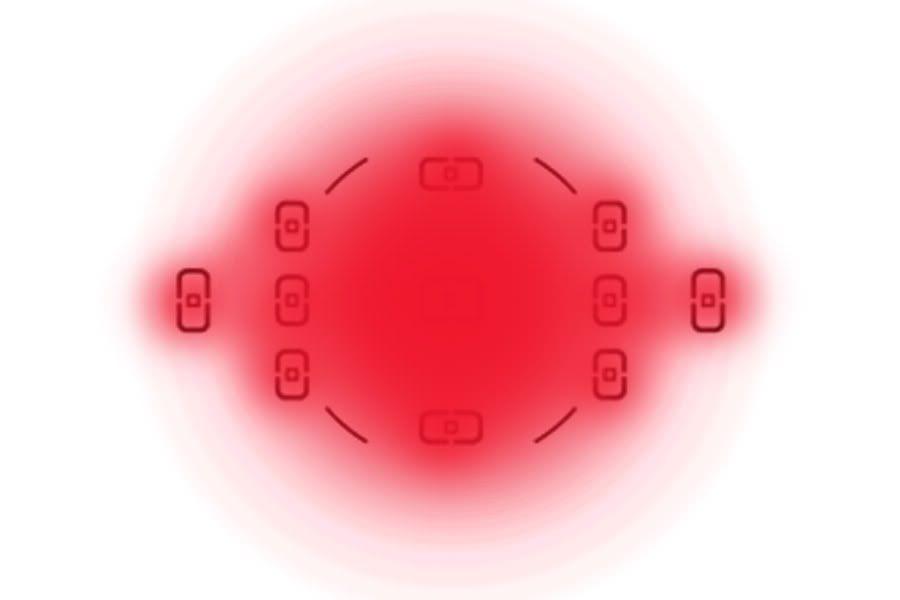
Another way of doing this test is with a black circle on a white background ... my D40 has 3 focus points .


As you can see the focus point diamond plays a very important role in how TTL-Bl meters .... how does canon flash compare ?


Test 4.)  A basic test that should give the same results in TTL and ETTLii mode .
Take a picture indoors where it is dark . iso 100 , F16 and 2 seconds [ the ambient must still be underexposed ] , use rear-curtain flash . Put your hand in front of the flash and take the picture - as you press the shutter the pre-flash will fire on your hand ..... move your hand away before the main flash fires - just before the shutter closes .... it should fire brighter than normal since it couldn't detect the pre-flash reading .
Something like this ......
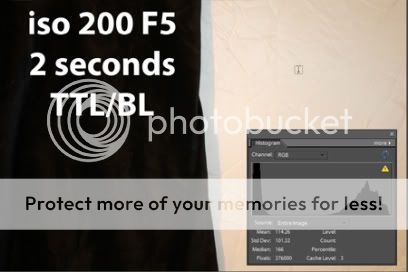
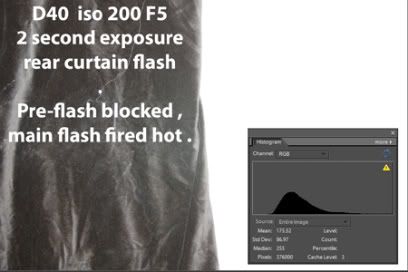

Test 5.) This is where it gets a little more complicated .
Set up your camera in manual on a tripod [ as you should have been doing ] . Take a picture of a subject with the ambient under-exposed by 4 stops using TTL mode and then in ETTLii mode .
they should look similar .
Then with the camera in manual mode still find the point where the meter shows correct exposure .
Take another picture in TTL mode and ETTLii mode . Most likely the picture in TTL mode will be much brighter than ETTLii which should register the fact that you have the ambient correctly exposed and compensate by backing off the flash .


Test 6.) [Similar to test 5 ] Slightly more complicated .

 Find a situation where CW metering and pattern metering give different readings - look at the following images ....
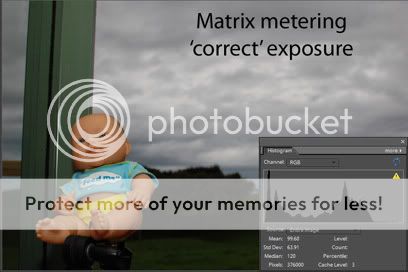
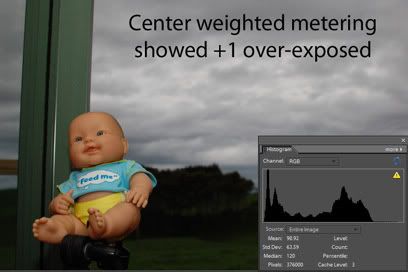
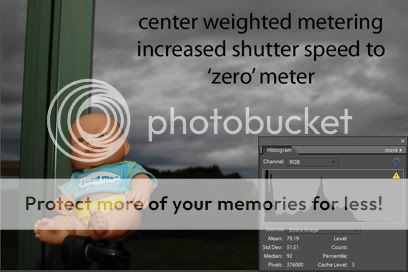
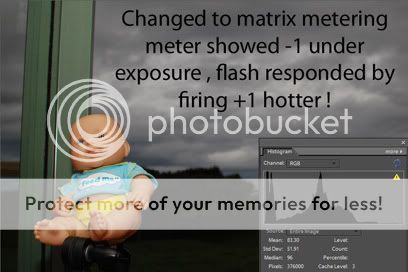

 What we are trying to do in this test is establish how ETTLii decides how well you have the ambient metered . With TTL-BL the evidence suggests that TTL-BL is 'watching the meter ' and as soon as the meter moves to show underexposure the flash output increases to compensate - even if the the settings haven't changed !
I was told that TTL-BL measures the 'RAW data' to determine what the lighting is like .... obviously this can't be the way it does it because regardless of what the light looks like the final exposure depends on the settings you have chosen and how you decide to expose the image .
So : Find a setting similar to my example where CW and Pattern metering give different readings . Set the camera so you are correctly exposed for the one mode and when you change to the other mode you get under-exposure [ according to the meter ] . Take a picture with ETTLii at 'correct' exposure and then simply switch to the other exposure mode , that tells you it is now underexposed , and without changing any other settings take another picture with ETTLii and see if the output has changed .

These images were submitted recently - both taken with a lens that does not provide distance information ....
The histograms are almost identical showing that the flash output was the same even though the focus distance changed - obviously ETTLii couldn't use distance info in the equation .


There was a difference in the images when manual focus was used and the camera did not confirm a focus-lock .... it then appears to simply expose for average gray on the brightest object in the scene .


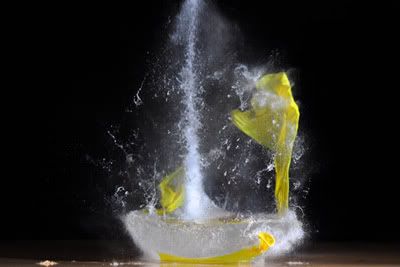
Fake high speed photography

Tonight I was feeling creative but didn't have too much time . I set up the sound activated flash trigger wired to two Nikon SB800 flashes set at 1/128th power . They fire at 1/41000th sec at this power .
Then I put my subjects on a wooden table and hit it from beneath with a hammer .....


It's nothing amazing but to someone who doesn't know how it was done it could look like really high speed photography :)


Sunday, July 4, 2010

Flash : Yongnuo RF-602 wireless transmitter


Today I tested my new Yongnuo RF602 wireless flash transmitter , this is what you get in the package .

When you look at the instructions you feel like contacting the manufacturers and asking them " Who learned you to spoke english so deliciously ? "

This is a close up view of the transmitter and receiver

  
Apparently the two back contacts aren't connected to anything inside which either means they are only there to make it look more 'functional'  or perhaps they are there because the next model [maybe the "903's"] will have TTL functionality !
It was also suggested that they may just be for other cameras and the wiring gets connected for the brand you choose .
There are contacts so you can use them to trigger the shutter release of some cameras at 100m .  


 Then I set up the tripod with my old SB24 so I could test the fastest trigger time    
[ which they advertise as being 1/250th sec - mainly because that's the fastest time most cameras can synch flash ] , and the furthest distance it could work at .


I used the D50 because it has an electronically switched sensor/shutter so it can synch flash at 1/500th sec normally and if it doesn't know there is a flash connected - as with a wireless trigger - there is no limit to the shutter speed you can use with flash .
I explain this in my blog on realsynch flash
Standing next to the flash I managed to trigger it at 1/800th second .


Then I took a walk across the farm and managed to trigger that flash from positions 1 , 2  and 3 . With position 3 I had gone out of range and had to walk back to that point to trigger the flash again ..... BUT : I could trigger the flash wirelessly at 1/800th sec from each of these positions .


And these are the results from those positions , all at 1/800th sec !
Tamron 17-50mm lens at 50mm .


I ran and took 96 large strides to get back so perhaps it is more than 100m .
As another test I took I went to the milking shed and placed the tripod with the flash on it behind a metal door and between two large metal tanks to make it as difficult as possible . The flash still fired ! I think that's covered every possibility that I could come up against at any distance I could need it to work at .


As a side issue we were discussing the possibility of transmitting wireless TTL on nikoncafe . This has been done with the radiopoppers but we  also spoke about the fact that the RF 602's wake up the SB800 flash from standby  mode with a half press of the button but can't wake the SB600's and won't let the SB900's go into sleep mode so we did some measuring and this is what mike66 of nikoncafe came up with ....

" Here is what I found on the left rear contact of the speedlights. When active, each contact had a DC component with a negative going square wave pulse. When in standby, the contact was zero Volts.
SB-900:
3.75V DC with a negative pulse of 40mV. The pulse width is 8ms and the period is 130ms.
SB-800:
4.00V DC with a negative pulse of 100mV. The pulse width is 8ms and the period is 250ms.

SB-600:
4.00V DC with a negative pulse of 80mV. The pulse width is 60ms and the period is 260ms.

The SB-800 had another interesting surprise on the front right contact, which neither of the other speedlights shared. When the speedlight was active, this contact had a positive going square wave pulse train of 2.5V. The pulse width is 2.5ms and the period is 250ms. When the SB-800 went into standby, the voltage on this contact was zero with no pulse train. "
As we learn more about the RF 602 wireless flash triggers perhaps we will find a way to make them work properly with the SB600 and SB900 . Perhaps Yongnuo will just make the next product work properly ? They probably took a D200 and SB800 and reverse engineered the contacts thinking that it would work with any flash .  For now anyway they are still a pretty powerful product considering what they can do compared to other cheaper flash triggers .


Flash : "Realsynch flash "

I'll state from the beginning : This will only work with a Nikon D40 , D50 or D70/S since they do not have a focal plane shutter , instead the sensor fires electronically which gives it the advantage of capturing the whole flash in one go as opposed to a slit moving across the frame as with Focal Plane [FP] shuters .


First off two samples to whet your appetite comparing what I call "realsynch" to the high-FP trick mode that modern cameras use in bright sunshine with high shutter speeds .
This is the best a Nikon D90 and SB800 can do at a distance of 5 metres ....
taken indoors at night .


Photobucket


And this is what "realsynch" does ....


Photobucket


I used a modified SB24 flash for my "realsynch" flash . Because the cameras mentioned fire electronically with their sensors they have a 1/500th flash synch speed meaning that since the SB800 , for example , fires at full power for around 1/1000th of a second the camera will be able to capture that entire flash in 1/500th of a second without any overlap in the timing of the electronics .
With a D90 this time is only 1/200th of a second and after that it changes to FP mode where the shutter slides across the frame in a slit - then it has to resort to a weak continuous light so the whole frame receives the same amount of light .... more on that later .


First we have to make sure the D40/50/70/S we are using doesn't know there is a flash connected and there are two options , either slide a piece of paper under the two back pins as you slide the flash into the hotshoe or do what I did - open the base of the flash and cut the two wires to the back two pins -BUT : be careful of high voltages , you could get zapped !
Now if you have an SB600/800/900 the paper trick is the safest if you are not 100% sure of what you are doing , also you don't want to damage a newer flash .
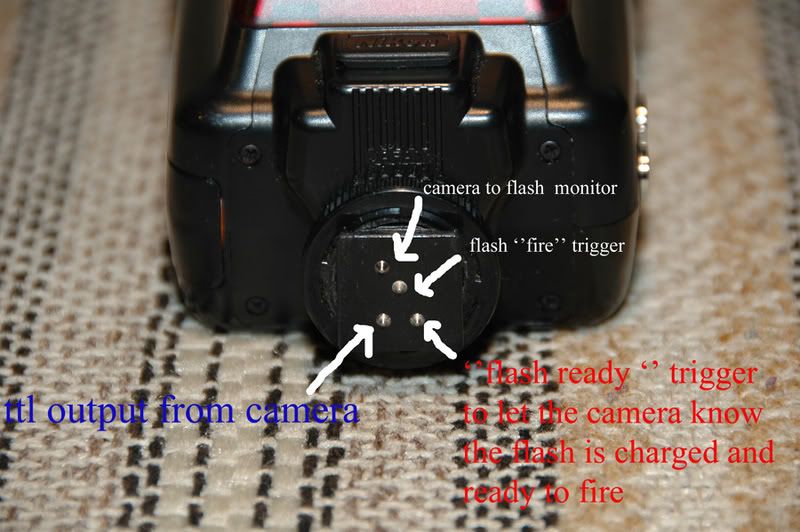
And this is a picture I took a while back to show the flash pins .


The centre pin gets earthed to the 'ground' contact on the side of the hotshoe when the camera wants it to fire . The single pin at the top is the 'camera to flash' communication pin .
The two at the bottom are for the flash to communicate with the camera so I disconnect them so the camera doesn't know the flash is connected and can't default to maximum synch speed .
In any case it doesn't speak the same language as the newer cameras so I have found that with my D40 and D50 I can fit an older flash without bypassing or blocking any of the pins and it still works at any speed , however I can't guarantee that there won't be any mis-communication between the camera and flash so I generally use my SB24 with the wires cut ....
I leave the one at the top connected because it is useful in that you can switch the SB24 to "standby " mode and when the camera is switched on that pin wakes the flash up - so the flash knows a camera is connected but the camera doesn't know a flash is connected !
Of course this means you have to input the aperture , iso and zoom of the head manually - but you can still leave the flash in 'auto' mode and it will use its sensor to control the flash output accordingly - based on the settings you have told it to use .
The advantage ? Well you can see that from the two pictures at the top ! Just a warning about the electrics in a flash ....


If we go by the 'sunny 16' rule : Bright sunlight at F16 gives you iso 200 and 1/200th max for the D90 . The SB800 tells me I have 2.7 metres working distance at this setting but when I open the aperture - F8 1/800th , F4 1/3200th ... the flash has to go to high fp mode and tells me I have 1.4 metres working distance .
Now the SB24 : F16 on the D50 allows me 1/500th sec at iso 500 , full power - which gives me 4 metres . f8 iso 200 1/800th full power is cutting it a bit fine to prevent overlap but as we drop in flash power it fires much faster . At 1/4 power it fires at 1/2700th sec and at 1/8 it fires at 1/5500th sec so at F4 1/3200th and iso 200 I can leave it on 1/4 and still catch a high percentage of the flash and have 4 metres working distance .
These distances are at 24mm wide angle on the zoom head and increase [ on both flashes ] as I zoom in and the power used would be enough to light a subject in total darkness as shown by the first two pictures . Of course outside in bright sunlight we would not need all that power and could use the flash as fill only , bounce it off a reflector , or close the aperture without changing the settings on the flash thereby fooling the flash to think it doesn't need to fire so strong [ increasing the iso setting on the flash will also reduce its power ] .
Here are two more pictures illustrating the power you have outside in bright sunlight .
Just remember one thing though , you have so much power available you may need to make sure you don't get too close to your subject/s since the flash may not be able to fire weak enough !


Photobucket
Photobucket


Now the 'rough' maths . Due to the inverse square law when you are twice as far from the subject - the light from the flash going forward in a 'rectangular' pattern means that the length and breadth of that 'rectangle' double and twice the length times twice the breadth = 4 times the area . So if you are getting twice the working distance it actually means you have 4 times the flash power ! The results may not agree 100% with the maths but they look close enough to prove that there is a huge advantage in 'realsynch' compared to high-fp mode .
So if the SB800 tells me I have 1.4 metres working distance and the SB24 tells me I have 4 metres then 4/1.4 = 2.85 X the working distance . 2.85 squared gives just over 8X the power !
That's 3 stops more powerful than a D90 and SB800 combination achieved with a lowly D40 and SB24 flash !
After doing some tests in manual mode without flash to get the same histograms as the first pictures [ not 100% but close ] it appears I am getting 2 1/3 to 2 2/3 stops more power than high fp mode .
I just did some calculations on the difference between normal flash and High fp on the SB800 , hopefully they are correct ;
When I set my camera manually to iso 200 , F16 and 1/200th sec the flash tells me I have 0.6-2.7 metres working distance available . As I take it to F8 1/800th or F4 1/3200th it goes into high-fp mode and tells me I have 0.6-1.4 metres . Now 2.7m/1.4m gives us 1.928X the distance . 1.928 squared tells us we have 3.72X the flash power when we are not in high-fp mode .
1/3.72 = 0.2688 which is the power we have in fp mode compared to normal flash mode .
That's less than 27% of normal flash power with a D90 and SB800 flash , when in high-fp mode .
At iso 100 and 35mm the SB800 has a GN of 38m and the SB24 a GN of 36m . By my calculations the SB24 has less than 90% of the power of a SB800 .
But when we start comparing "realsynch" to high fp mode the SB24/D40 combination has almost 8X more power at higher shutter speeds due to the faster flash synch speed !


Today I did some tests to try to turn "day into night " .
First a picture without flash .
Photobucket


Under expose the background by increasing the shutter speed ...
Photobucket


And with the D40 , [35mm 1.8 lens] and SB 24 we still have enough power at 4 meters to make the picture look like a bad 'direct flash' shot at night !


Photobucket