Ok well I've been doing more tests and calculations on the subject to try and figure out why we lose so much power as we start going into auto-fp mode and think I just worked it out .
Auto-fp flash logically must stay on for longer for slower shutter speeds .
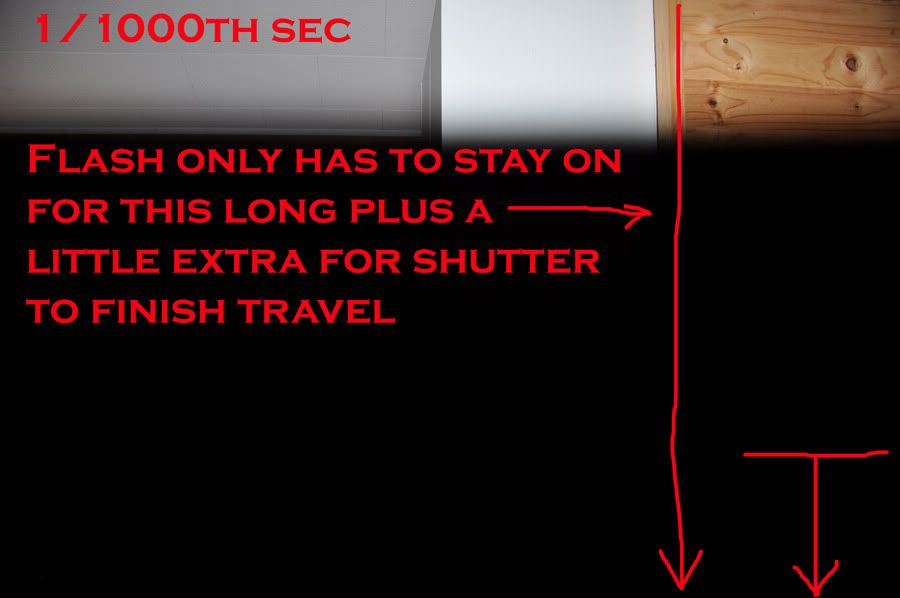
Let's take 1/1000th sec first , the flash must start 'pulsing' before the first curtain opens - then it must last for 1/280th sec [ if that's how fast the curtain moves ] but once the first curtain reaches the other side it must stay open for the duration of the slit that still has to close !
At 1/1000th sec let's say that slit is 1/4 of the frame = another 1/1120th of a second.
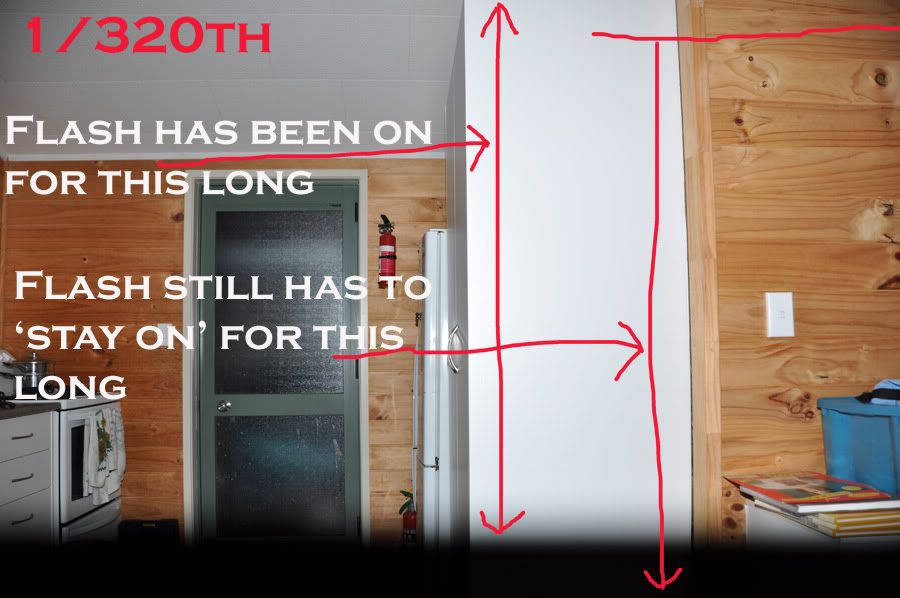
Now we look closer at the slit at speeds closer to normal sync .
1/320th shows a much larger slit [ 3X the size of 1/1000th?]
Now after the first curtain moves across the frame [ 1/280th sec] the flash still has to remain on until the second curtain is closed which will now take 3X as long as at 1/1000th = 3/1120th = 1/370th sec extra !
This would explain why the first drop into auto-fp mode gives us so much less power than 1/2000th .
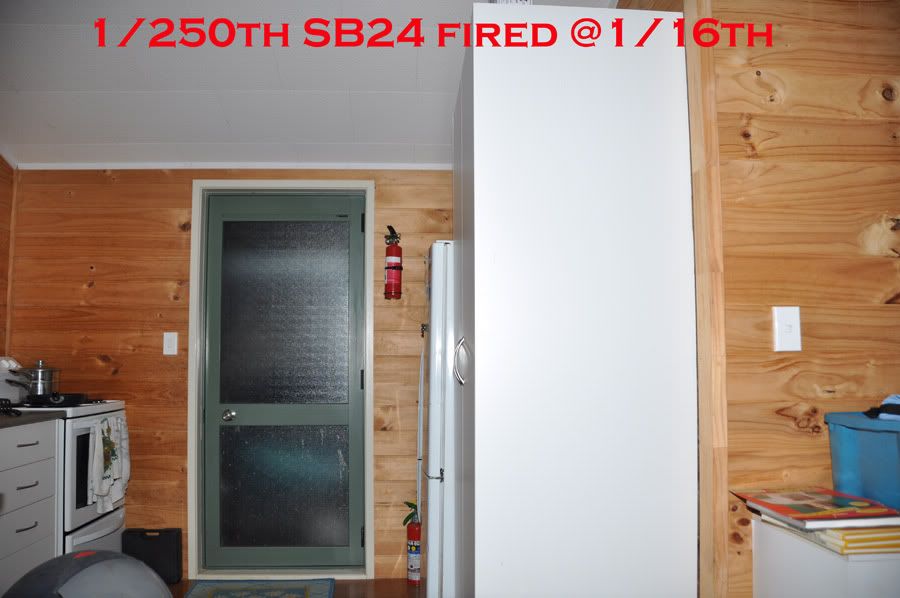
When I fire the SB24 at 1/16th on the D90 at 1/250th sec I don't see the curtain starting to close yet though sync speed is back at 1/200th .
This means that when the flash goes into fp mode it is doing so over 1/280th sec plus the 1/250th sec that the rear curtain takes to close cutting the total power in half [approximately ] .
So auto-fp would have to push out around half as much power over twice the time as opposed to around 1/250th sec shutter travel at 1/4000th sec - not counting the power before and after the pulse .
So essentially different shutter speeds would vary how long auto-fp stays on , and how much power it pushes out over that time period resulting in the differences we see between 1/250th and 1/2000th in auto-fp mode !
Sunday, August 29, 2010
Saturday, August 28, 2010
Friday, August 27, 2010
auto-fp flash power tests
This afternoon I did some tests to compare the power of auto-fp to normal flash . I used a solid white wall and kept the flash set at 1/1 full power and also made sure I kept the ambient level [which was very under-exposed ] the same , to simulate a situation where we would keep our ambient settings in the same place while reverting to auto-fp mode .
I aimed to get the same histogram in each shot and it was interesting how much difference a few cm made when I made adjustments .
This is what I aimed for :
After each change in settings I moved the camera until I got the same histogram and then measured the distance to the flash head so I could calculate the power difference compared to normal flash .
F25 1/200th normal flash 195cm
F22 1/250th auto-fp mode 68cm = 1/8th of normal flash power
F16 1/500th 88cm = 1/5
F11 1/1000th 120cm = 1/2.6
F8 1/2000th 136cm = 1/2
F6.3 1/3200th 120cm = 1/2.6
F5.6 1/4000th 112cm = 1/3
My conclusion is that due to the way auto-fp works even though the flash head suggests the same working distance at any of these settings when in auto-fp mode it appears that the combination at 1/2000th sec yields the greatest output , after which the curve drops off again .
Since auto-fp flash behaves as a continuous light the slower the speed the more energy it requires ! So faster shutter speeds mean that light is 'switched on' for shorter times , not counting the short period before the shutter opens and after it closes that it will need to be on . This should also result in faster charge times .
In other words , when you revert to auto-fp mode stay away from the the slower speeds and aim for 1/2000th sec and the aperture that gets you the results you want to get the most flash power possible in this mode .
.
The results :
Wednesday, August 25, 2010
Auto-fp power loss
I've read varying opinions on how much flash power you have in auto-fp flash mode at high shutter speeds .
This weekend I will devise a test to see what results I get .
The distance info reported on the flash head suggest you have a little over 25% of the power of normal flash [ 2 stops less ] but many are reporting 2.3 to 2.6 stops less power .
This weekend I will devise a test to see what results I get .
The distance info reported on the flash head suggest you have a little over 25% of the power of normal flash [ 2 stops less ] but many are reporting 2.3 to 2.6 stops less power .
Subscribe to:
Posts (Atom)


