About 10 years ago I was talking to a salesman in a Hi-Fi shop about the 'new' "7 channel " surround sound system and asked him why we need 7 channels . He replied that we may not actually 'need' it , but as long as the technology is available people will utilize it .
And that's about the way it is today with digital cameras . We can do a lot with a basic camera but the manufacturers need to sell their products and compete with one another , which is good for us actually because it means better products at competitive prices . But this often results in new 'gimmicks' that none of really need - but help to bias someone's decision when buying a new camera .
Let's take face detection as an example . How many professional photographers thought we needed that !? Then it progressed to profile-face detection , multiple face detection , smile detection , blink detection ..... all these extra 'features' to make the 'old' technology seem outdated and redundant so we want to upgrade .
So where will this take us ? It's not too hard to work out what possibilities there are for the future no matter how ridiculous they may sound - manufacturers need to give people a reason to upgrade or make their products our first purchase .
Possibilities :
GPS linked internet mode . With the ability to track where a photograph was taken built in to some cameras this may become 'standard' eventually as the manufacturers struggle to keep up as well as compete with each other . There are many "modes" available in compact cameras , beach , snow , museum , fireworks .......
Now imagine if there was the option of just one "auto smart location" [ASL] mode to save granny having to learn how to use her camera .
When compacts are permanently connected to the internet , along with built in GPS all tied in with google-earth the new smart location mode will be able to detect where you are , whether you are inside or outside a building , work out whether you are at the beach or in the snow - if there is actually snow at that time of the year , what time it is ........ a quick automatic internet search on 'events' in the area along with a program of the event - and next thing you know the camera has selected fireworks mode because it is 9 pm and that is when the fireworks display starts and according to the stored information you have been waiting in that area for half an hour -after you spent 45 minutes in the cafe' and the camera orientation sensor shows it is on a tripod pointing in the direction of the field where the display will be held ...... not impossible to conceive is it ?
Or it might check your location and determine that you are in a museum and turn off all sounds and flash .....
Most of us don't want or need that kind of automation but the newer [and older] generation will embrace it .
The built in program and internet connection could work out that you are on the beach - a weather search could show that it is a clear sunny day and the orientation sensor could detect that you are pointing the camera slightly upwards at someone on the wharf next to you , as it has checked the location with google-earth , the 'content aware' program has detected the wharf which would be easier than face-detection [it will have read its description from a map as well] , and provide the exact compensation for the bright sky the meter will detect in the background .
It will be able to work out the position of the sun at that time of the day along with the direction you are pointing the camera and make the appropriate adjustments .
As it examines past images from google earth it will be able to determine the colour and reflectivity of the beach sand , some beaches have black sand and normal 'beach mode' would give incorrect results if an ill-informed beginner selects that mode in such a case . ASL mode will not be fooled by the fact that it is on a beach according to the GPS - it will have done its homework as soon as it was turned on and realized that the sand was still dark and it would know that it wouldn't need to increase exposure compensation .
Once it has determined its settings for the location and weather the live-view will be able to analyze the subject you are photographing . My Casio FH100 has an 'enter scene' mode that detects movement and takes pictures when something happens . It wouldn't be too hard to take that a step further and allow the camera to analyze the scene that is unfolding before it . It could lock-on to the stationery subjects , work out how much granny's hand is shaking , calculate the speed that the grand-kids are running at and then select a suitable shutter speed . If it detects no movement it would adjust accordingly and perhaps choose a smaller aperture considering the subject is most likely a landscape image .
Many compact now have automatic "help"[?] tips that show up on the screen . Imagine if you are photographing the afternoon sun going down , an internet search suggests that there is light rain in the area
but it is clear in the area where the sun is going down - a quick calculation regarding the angle of the sun and direction the camera is actually pointing ..... and the screen gives a beep and pops up on the display " Check for Rainbows behind you " ..... now when all their models of one brand are interlinked and registering "clicks" from other cameras around you there may even be an alert on the screen " something interesting happening 1km away " .
But there's also the possibility of something new that professionals might actually like .
The Nikon D300 came out with a networking capability so that perhaps 5 cameras could be wirelessly linked at an event so images could pop up on a laptop display as they are taken .
Imagine a serious photo-shoot , perhaps a wedding or news-worthy event . Many pro cameras have dual card slots so you can have back-up in case one card fails and loses all your images . Along with the wireless internet possibility imagine if your images could constantly be uploading at their full file size to the internet while you are photographing an event - your computer could be on at home busy downloading them at the same time . If needed your assistant could be busy processing those images while you are shooting and either sending them back to your camera for approval or preparing them for a slide-show of the days pictures at the wedding reception or racing event .
As with the internet itself these changes can and will introduce many problems of their own - that's what technology is all about though :)
They will have to make sure you are not in the middle of something important when the screen pops up " new firmware download available- start download ? " .
Saturday, September 11, 2010


Wednesday, September 8, 2010
My latest photovan adventure
I failed an attempt at sleeping in the snow due to not enough insulation under me .
The full story is on my photovan blog
And a few pictures from the trip with my Casio FH100 .....


And some from the D90


The full story is on my photovan blog
And a few pictures from the trip with my Casio FH100 .....


And some from the D90


Saturday, September 4, 2010
Turbo flash
Warning : the capacitors in a camera flash can hold up to 600 volts which can kill you ! Don't attempt this if you don't know exactly what you are doing !
I recently did some experiments with an older flash to see how easy it would be to boost the output of a flash . I measured the voltage at the base of the flash and it was 220 volts . My D50 is rated at 250 volts so I put it on the camera and fired it . Not very impressive .


Then I took the old capacitor from my SB400 flash and joined the capacitor wires to that instead ...
Much brighter though it did take 5X as long to charge up , it only has one AAA battery in it .


I then tried a more controlled experiment to compare it to my SB800 flash .


Then I left the original capacitor in the flash and added two more to give it a boost .

That made it more powerful than my SB800 !

My thoughts are that since the capacitor is basically a small 'battery' it will only accept the voltage the charging system puts into it and adding more 'batteries' means the same voltage but a higher current so the flash tube can fire for longer .
As with any flash you wouldn't want to fire it at that power too often
because the tube could overheat but it's certainly handy to know that you could boost the output of a flash by adding a capacitor .
16/10/2010
I got hold of a 3500uf capacitor which is only about 4 1/2 X as powerful as a SB800 capacitor .
I wired it in parallel with the flash tube of my old Sunpak GT pro 4011 flash and tested its output compared to a full power blast from an SB600 .

 It is considerably more powerful but I need to do some more tests with it to see how long the tube lasts . I imagine if it is anything like the duty cycle of a welder , for example , and the normal flash is capable of firing at full power 4 times in a minute then this would perhaps be able to fire once a minute for exactly the same heat build up . I suppose time will tell .
19/10/2011 .
This afternoon I decided to put the new "mutant" flash through its paces to see what it could do .
I fired it about 15-20 times all together without giving it much time to cool down .
I took a few shots to compare it to the SB800 on full power .Ignore the background getting brighter , it was raining and the sun was coming out again . Concentrate on the foreground and shadows .
I used the D50 because it can sync flash at any speed .


I had the "super-flash" on half power which was half the capacitors in the original flash plus the 3500uf cap I added .

Then I moved up the driveway to really put it to the test ....


I then moved to the top of the driveway . And tried at 1/3200th sec .


I would imagine the flash tube will last as it doesn't appear to have suffered any side effects .
"Full power " is when the other half of the capacitor bank inside the flash handle is also connected.
I recently did some experiments with an older flash to see how easy it would be to boost the output of a flash . I measured the voltage at the base of the flash and it was 220 volts . My D50 is rated at 250 volts so I put it on the camera and fired it . Not very impressive .
Then I took the old capacitor from my SB400 flash and joined the capacitor wires to that instead ...
Much brighter though it did take 5X as long to charge up , it only has one AAA battery in it .
I then tried a more controlled experiment to compare it to my SB800 flash .
Then I left the original capacitor in the flash and added two more to give it a boost .
That made it more powerful than my SB800 !
My thoughts are that since the capacitor is basically a small 'battery' it will only accept the voltage the charging system puts into it and adding more 'batteries' means the same voltage but a higher current so the flash tube can fire for longer .
As with any flash you wouldn't want to fire it at that power too often
because the tube could overheat but it's certainly handy to know that you could boost the output of a flash by adding a capacitor .
16/10/2010
I got hold of a 3500uf capacitor which is only about 4 1/2 X as powerful as a SB800 capacitor .
I wired it in parallel with the flash tube of my old Sunpak GT pro 4011 flash and tested its output compared to a full power blast from an SB600 .


19/10/2011 .
This afternoon I decided to put the new "mutant" flash through its paces to see what it could do .
I fired it about 15-20 times all together without giving it much time to cool down .
I took a few shots to compare it to the SB800 on full power .Ignore the background getting brighter , it was raining and the sun was coming out again . Concentrate on the foreground and shadows .
I used the D50 because it can sync flash at any speed .


I had the "super-flash" on half power which was half the capacitors in the original flash plus the 3500uf cap I added .

Then I moved up the driveway to really put it to the test ....


I then moved to the top of the driveway . And tried at 1/3200th sec .


I would imagine the flash tube will last as it doesn't appear to have suffered any side effects .
"Full power " is when the other half of the capacitor bank inside the flash handle is also connected.
Friday, September 3, 2010
auto-fp flash
First of all what is "fp"-flash and why do we need it ?
FP stands for "focal plane"[ see the definition on the link ] .
At slower shutter speeds [ I'll refer to the limits of the D90 from now on ] up to 1/200th sec there is enough time for the shutter to open and for the flash to fire before the shutter closes without any problems .
But as you move into faster speeds the shutter starts using a slit to increase speeds and this means that the flash would only fire during the first stage of that slit and not show again on the image since the flash fires in between 1/700th and 1/41600th sec [ SB800 ] .
Here's an example , taken with the D90 and an old SB24 flash - since they don't speak the same language the camera fired the flash at any speed I chose .

At 1/1000th sec we can see when the flash fired while the rest of the image is black since that is the slit we see at the top . If you use 1/1000th sec the shutter can't move fast enough to do that speed .
How fast can the shutter move ?
We'll choose an easy figure to work with here so let's say the shutter curtain can only complete the trip across the frame in 1/250th sec[4ms] , so if you want 1/1000th sec it has to move a slit 1/4 of the size of the screen across the frame [ 1/250th/4 = 1/1000th ] .
As we see from the results the flash fired so quickly , 1/11000th sec actually , that it only lights up that 1/4 of the frame and then it's over.
So if we need to use a faster shutter speed , usually when shooting outdoors in bright sunlight and wanting to use a wider aperture , the flash needs to "stay on" for the whole time that slit is moving .
The manufacturers achieve this by firing the flash in a series of very fast pulses so the flash essentially becomes a 'continuous light' for the duration of the shutter travel .


 The problem is that much of this light is wasted on the back of the shutter curtain and only a small amount reaches the sensor through that slit which is the major disadvantage of auto-fp flash .... it loses a lot of power . That's the trade-off you pay for using higher shutter speeds than normal flash can handle .
How much power ?
We'll work off the 'sunny 16' rule [ On the brightest sunniest day if your iso and shutter speed are equal then you will be at F16 for correct exposure ] .
I set my camera to F16 iso 200 1/200th sec and the flash head tells me I have 5.0 metres working distance .
When I move into the higher speeds and fp mode the flash tells me I have 2.7 metres working distance at any setting that would give me an equivalent exposure for the ambient .
If F16 and 1/200th give us correct exposure then we would use perhaps F8 and 1/800th , F4 and 1/3200th etc .... For each increase in exposure via the aperture we decrease the exposure with the shutter speed so the ambient exposure is consistent .
Now since fp-flash behaves as a continuous light that should mean that in fp mode each equivalent exposure should give us the same results with the flash .
Actual tests prove different .

So why does the flash power drop off so rapidly and then climb again ?
It appears to be directly related to the concept of the focal plane shutter . Even though the shutter always moves at a constant speed , or more likely 'especially' since the shutter is 'limited' to a constant speed , the slower speeds means it takes longer to for the shutter to complete the exposure .
Here's an image taken at 1/250th which is faster than the limit of the D90 . At low power and fast flash speeds there is no problem but if we tried to fire at full power the shutter would start closing before the flash was finished it's output and give us a dark patch at the top .
 So the first curtain opens in about 1/250th sec[4ms] , then the second curtain closes and takes another 1/250th sec[4ms] to complete the exposure .... 8ms in total .
When we take a picture at 1/1000th sec the slit is 1/4 as wide and therefore only takes another 1 ms to complete its travel [ 1/1000th = 1ms ] . At 1/4000th the slit is so thin that it takes 4ms plus 0.25ms for the entire exposure , and here's a graph of the relationship between shutter speed and "total shutter travel time ":

Notice something interesting ? On both graphs it levels out at about 1/2000th sec .
The only logical conclusion is that at slower shutter speeds auto-fp is limited to a lower power output to stay on for the longer time it takes for the second curtain of the shutter to complete its travel .
About 8.5 ms at 1/250th , compared to 5ms at 1/4000th [ it would have to come on slightly before and stay on until slightly after the shutter opens and closes ] This has recently been demonstrated by some tests on this blog . .
I am told that the graph will look quite different for a D700 and that the longest time for a D700 will be 4.5ms and the shortest time around 2.1ms . This would explain why similar tests done with a full frame camera show less power loss , the shutter moves much faster and the 'total shutter travel time' is shorter meaning that the flash can fire stronger for a shorter period of time .

So we learn from this that the nature of the focal plane shutter and how it works with fp flash means that the initial stages of fp mode , at the shutter speeds just past the flash's normal sync speed , give the lowest effective flash output .
Essentially it is the same amount of energy , only it is less power spread out over a longer time to accommodate the longer 'total shutter travel time' .
As we move into the faster shutter speeds we see an improvement due to the fact that the flash capacitor can be discharged over a shorter time allowing a higher output .
Think of it as a fast burning candle , at 1/250th we burn the candle which lasts 8ms . At 1/4000th we burn the same candle at both ends , it's twice as bright but lasts half as long .
With fx and a faster shutter travel we can almost start by burning the candle at both ends and advance to also burning it in the middle !
In practice this means that if you want to use a wider aperture don't think that staying closer to normal flash sync is going to put less strain on the system - it does the opposite so rather move as quickly as possible to the faster speeds when using fp mode .
You will have about half the working distance which is 2 stops less power using fp mode .
Initially though , you will lose around 3 stops of power at the slower fp speeds .
.
FP stands for "focal plane"[ see the definition on the link ] .
At slower shutter speeds [ I'll refer to the limits of the D90 from now on ] up to 1/200th sec there is enough time for the shutter to open and for the flash to fire before the shutter closes without any problems .
But as you move into faster speeds the shutter starts using a slit to increase speeds and this means that the flash would only fire during the first stage of that slit and not show again on the image since the flash fires in between 1/700th and 1/41600th sec [ SB800 ] .
Here's an example , taken with the D90 and an old SB24 flash - since they don't speak the same language the camera fired the flash at any speed I chose .
At 1/1000th sec we can see when the flash fired while the rest of the image is black since that is the slit we see at the top . If you use 1/1000th sec the shutter can't move fast enough to do that speed .
How fast can the shutter move ?
We'll choose an easy figure to work with here so let's say the shutter curtain can only complete the trip across the frame in 1/250th sec[4ms] , so if you want 1/1000th sec it has to move a slit 1/4 of the size of the screen across the frame [ 1/250th/4 = 1/1000th ] .
As we see from the results the flash fired so quickly , 1/11000th sec actually , that it only lights up that 1/4 of the frame and then it's over.
So if we need to use a faster shutter speed , usually when shooting outdoors in bright sunlight and wanting to use a wider aperture , the flash needs to "stay on" for the whole time that slit is moving .
The manufacturers achieve this by firing the flash in a series of very fast pulses so the flash essentially becomes a 'continuous light' for the duration of the shutter travel .
How much power ?
We'll work off the 'sunny 16' rule [ On the brightest sunniest day if your iso and shutter speed are equal then you will be at F16 for correct exposure ] .
I set my camera to F16 iso 200 1/200th sec and the flash head tells me I have 5.0 metres working distance .
When I move into the higher speeds and fp mode the flash tells me I have 2.7 metres working distance at any setting that would give me an equivalent exposure for the ambient .
If F16 and 1/200th give us correct exposure then we would use perhaps F8 and 1/800th , F4 and 1/3200th etc .... For each increase in exposure via the aperture we decrease the exposure with the shutter speed so the ambient exposure is consistent .
Now since fp-flash behaves as a continuous light that should mean that in fp mode each equivalent exposure should give us the same results with the flash .
Actual tests prove different .
So why does the flash power drop off so rapidly and then climb again ?
It appears to be directly related to the concept of the focal plane shutter . Even though the shutter always moves at a constant speed , or more likely 'especially' since the shutter is 'limited' to a constant speed , the slower speeds means it takes longer to for the shutter to complete the exposure .
Here's an image taken at 1/250th which is faster than the limit of the D90 . At low power and fast flash speeds there is no problem but if we tried to fire at full power the shutter would start closing before the flash was finished it's output and give us a dark patch at the top .
When we take a picture at 1/1000th sec the slit is 1/4 as wide and therefore only takes another 1 ms to complete its travel [ 1/1000th = 1ms ] . At 1/4000th the slit is so thin that it takes 4ms plus 0.25ms for the entire exposure , and here's a graph of the relationship between shutter speed and "total shutter travel time ":
Notice something interesting ? On both graphs it levels out at about 1/2000th sec .
The only logical conclusion is that at slower shutter speeds auto-fp is limited to a lower power output to stay on for the longer time it takes for the second curtain of the shutter to complete its travel .
About 8.5 ms at 1/250th , compared to 5ms at 1/4000th [ it would have to come on slightly before and stay on until slightly after the shutter opens and closes ] This has recently been demonstrated by some tests on this blog . .
I am told that the graph will look quite different for a D700 and that the longest time for a D700 will be 4.5ms and the shortest time around 2.1ms . This would explain why similar tests done with a full frame camera show less power loss , the shutter moves much faster and the 'total shutter travel time' is shorter meaning that the flash can fire stronger for a shorter period of time .
So we learn from this that the nature of the focal plane shutter and how it works with fp flash means that the initial stages of fp mode , at the shutter speeds just past the flash's normal sync speed , give the lowest effective flash output .
Essentially it is the same amount of energy , only it is less power spread out over a longer time to accommodate the longer 'total shutter travel time' .
As we move into the faster shutter speeds we see an improvement due to the fact that the flash capacitor can be discharged over a shorter time allowing a higher output .
Think of it as a fast burning candle , at 1/250th we burn the candle which lasts 8ms . At 1/4000th we burn the same candle at both ends , it's twice as bright but lasts half as long .
With fx and a faster shutter travel we can almost start by burning the candle at both ends and advance to also burning it in the middle !
In practice this means that if you want to use a wider aperture don't think that staying closer to normal flash sync is going to put less strain on the system - it does the opposite so rather move as quickly as possible to the faster speeds when using fp mode .
You will have about half the working distance which is 2 stops less power using fp mode .
Initially though , you will lose around 3 stops of power at the slower fp speeds .
.
Sunday, August 29, 2010
What is Fill-Flash?
I've seen various opinions of what 'fill flash' is . My thoughts are that it is when the ambient is the main light source and you only want to lift the shadows with a small amount of flash .
As you underexpose the ambient and use more flash you start tending toward 'fill ambient' where the flash is the main light source and you 'drag the shutter' to expose some of the background as well .
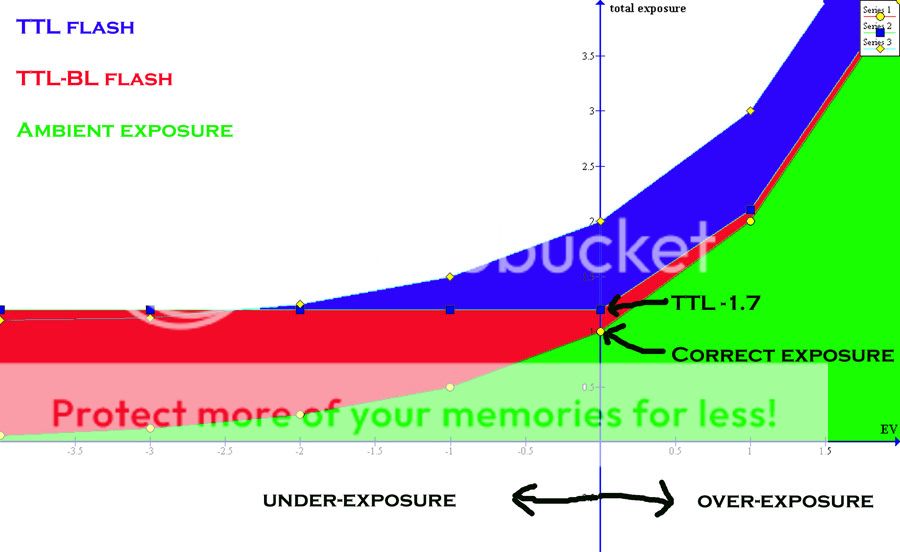
So I just thought I'd share the graph I just made showing the relationship between exposure , TTL flash and TTL-BL flash since Nikon defines TTL-BL as "Balanced fill flash" .
.
As we see TTL flash maintains the same output regardless of where you have the ambient exposed - it doesn't know or care how well you have the ambient exposed - it thinks it is the only light source .
This is why we need to dial in more negative flash compensation when we use TTL flash and the subject is already properly exposed .
TTL-BL on the other hand 'watches the meter' and in situations where they meter evenly [ a centralized subject filling the middle of the frame ] TTL-BL will back off to the equivalent of TTL -1.7 stops to simply act as 'fill flash' .
As we under-expose the ambient TTL-BL steps in and starts to take over control of the exposure of the subject .
The graph I've shown is the result of some controlled tests I did using a flash meter to determine the difference in their output in varying situations .
Subscribe to:
Posts (Atom)


 Posts


