skip to main |
skip to sidebar
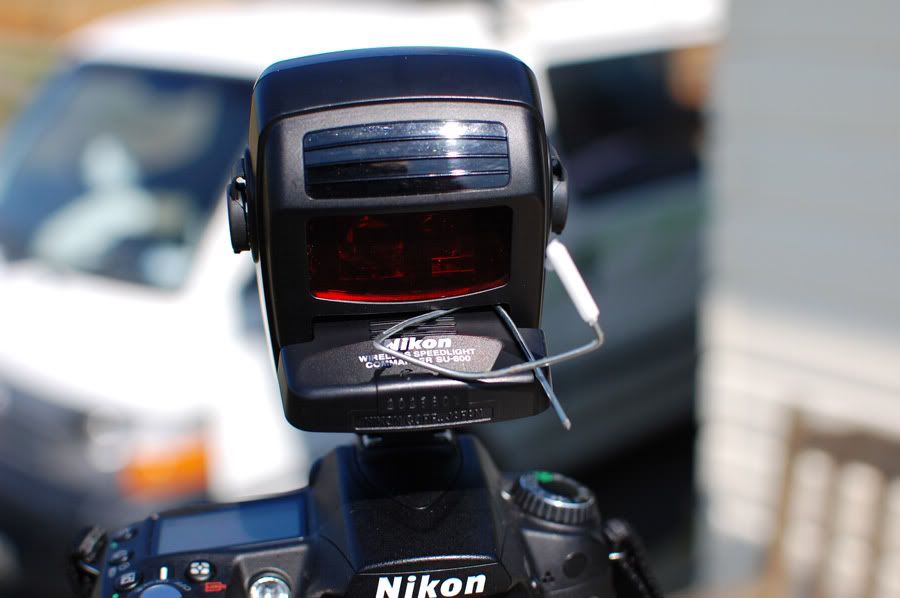
For some this may be common knowledge but today I was doing some experiments with the SU800 outdoors .
I had the SB800 on a stand behind me in remote mode firing at 1/128th power and kept changing the angle of the camera until it would no longer fire .
When they were both pointing toward that fence it fired every time even with the flash behind the camera - maybe it was bouncing the signal off the fence ?
Anyway I reached an angle when the SB800 would no longer fire ...
You kind of wonder why Nikon would make the trigger system facing directly forward which is the last place anyone would have their lighting .
Then I added something to the equation , without moving anything , which made it fire again ....
I had tried simply placing my finger in front of the SU800 and that worked , the signal bounced off my finger and triggered the flash behind the camera .
I just added this little white object in front of the SU800 which bounced the signal backwards and made the flash fire every time .
I see possibilities here , for the SU800 and SB800 , I think I could design something that attaches to each of them to send and receive signals from any angle - or at least increase their reliability in some situations .
.
I was just thinking about this - many compacts have facial recognition which could make getting the dorrect exposure easier - assuming a certain skin colour of course .
The biggest problem with flash metering is knowing what to meter off .
Nikon's new 2012 segment metering is perhaps a step in the direction of eventually being able to have facial recognition built in to the camera meter , as with live view , which could result in much more accurate flash exposure if the camera can differentiate between what is and isn't a face .
I'll just emphasize here that the flash does not meter off the selected focus point , the change has nothing to do with the way the flash system meters .
This will also only happen in TTL-BL mode and with Nikon's CLS wireless flash which also meters in TTL-BL mode . The possibility of it happening falls within a very small window of the metering system - when the meter detects under-exposure causing the flash system to compensate by increasing output , or conversely by decreasing output if it detects that the exposure is suddenly correct after it showing as being under-exposed .
The possibility of this happening when a focus point is moved also depends heavily on the metering mode selected [ it must be matrix metering ] and how matrix metering works in that particular body - because it varies between models .
I used the Nikon D90 in these tests , I've tested the matrix metering system before and understand [ to a degree] how it 'thinks' .
In many of the Nikon's [ not too sure about Canon ] matrix metering is strongly weighted toward the selected focus point and the 'focus plane' that it sits on , and it adjusts exposure accordingly .
This means that if you are photographing a landscape and move the focus point from bright sky to shadow area "in the same frame" your exposure could vary by as much as two stops without even moving the camera .
Now it has been suggested that the changes seen in flash output are not due to the metering but rather due to the change in distance info from the lens which affect the output of TTL-BL flash [ not wireless which doesn't use the distance info ] .
This will cause changes as well but not the type I am demonstrating here . I have selected a scene in which the darker object which causes the an increase in output , is actually closer than the lighter object proving that the change in this case is not related to distance info from the lens .
Here is my test scene , the back of a camera closer to the camera with a white multi-plug adapter further back .
Theoretically when I change the focus point from the white object to the black object closer to the camera the flash exposure should decrease as the lens registers a closer focus point .
First I take a picture with the focus point moved onto the white object :
Then I move it onto the black object closer to the camera .... the flash exposure increases !?!
Why did that happen ?
Well TTL-BL and wireless CLS 'watch your meter" and adjust output accordingly .
Here's the back of the screen in the first shot :
The camera's meter was happy with the exposure with the focus point on the white object - that 'focus plane' decided that the camera's settings were correct for the scene so the camera told the flash to back off accordingly .
After taking the picture I simply moved the focus point onto the black object closer to the camera , which should have backed off the flash according to the distance info , but when the 'focus plane' shifted and the white object was no longer a dominant part of matrix metering's equation it decided that the image was under-exposed and the meter moved to "-1"
No camera settings were changed , the focus point was simply moved .
The flash output was increased because matrix metering decided that the scene , for that focus point , was under-exposed and so it decided to increase the flash output accordingly !
So this proves that regardless of the changes caused by the distance information from the lens , there are isolated instances where flash output can be affected by moving the focus point in the same scene with no other changes to the camera's settings :) .
With photokina just around the corner , and the release of the new D7000 there is general disagreement about whether this is a replacement for the D90 or the D300s .
My thoughts are that it is something in-between ... a "tweener" .
Not quite enough specs to replace the D300 on all counts but too many to be a D90 replacement .
I'm thinking that Nikon are perhaps priming us for the release of another pro dx camera which disappeared when the D3 was released . The D3 was the wrong name for a full frame camera , it should have had a different name since it was in a very different class to the D2X [ fx format vs dx format ] .
We had the D1 , D100 and D70 , then the D2 series , D200 and D80 , next the D3 , D300 and D90 .
The D3 should have been a dx format for those who want a pro body in dx format and the fx format should have had another name and been in a different class .
So Nikon start running our of names for the different models and things are getting messy with the numbering so they name their entry level model the "D3000" giving it room for the D3100 , 3200 , 3300 .... for a few years of updates . This camera is the 'bait' to get beginners to buy a Nikon body cheap - and pay more for lenses that can focus on it .
Then the D5000 series , no focus drive either but a few more features for those who want a little more .
Also plenty of room for updates without changing numbers , 5100 , 5200 , 5300 ........
So we can expect the "thousand' numbering system to prevail in all models including the replacement for the D90 and D300 . People have been expecting a D400 and D95 but I doubt that those numbers will ever appear .
So perhaps the D7000 is slightly below the standards of the expected "D400" so that their next dx body can be that much higher than it - a pro dx body with 11 fps etc. etc. - a D9000 maybe ?
Then the D90 replacement would fall between the D5000 and D7000 - a plastic body with built in focus drive - a D6000 .
But then again what if they pull the same trick they did with the D50 giving us a D40 with no focus drive ? is their plan to slowly phase focus drives out of the lesser bodies so we have the choice between a cheap body and buying expensive lenses to focus with it , or having to upgrade to a more expensive body so we can use the older lenses ? That would mean a D5100 with no focus drive as the only other option - same sensor as the D7000 with less features .
And why did they name the entry level camera a "D3000" ? you would think they would make it a D1000 but maybe they have better plans for the nicer sounding "1000" .
So we have entry level D3000 to D3100
One step up D5000
Keen amateur from D90 to D6000 ?
New semi-semi pro D7000
In between the replacements semi-pro D300 - not to be replaced .
New pro dx body D9000
Update for D3 D1000
Update for D700 D2000
So the question is if we will a D6000 or a D5100 which tells us " no more focus drive unless you upgrade "
Of course this is all pure speculation but interesting to think about :)
.





 Posts

